
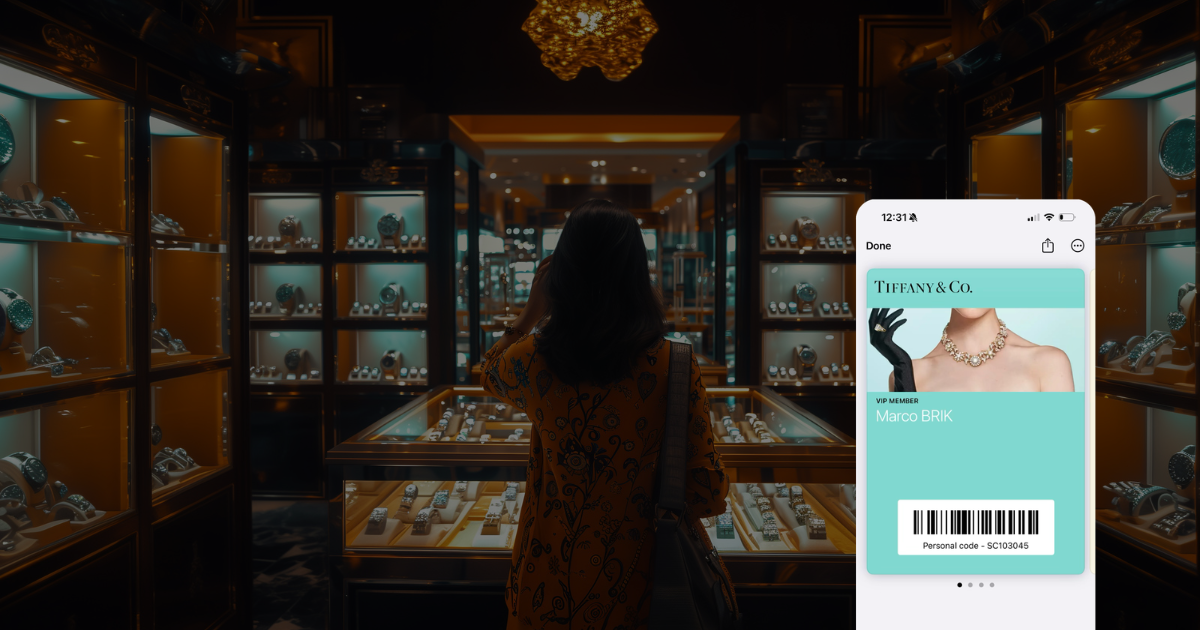
There is a scene every luxury professional knows well. A client walks into a store. The advisor recognizes them, smiles, calls them by their first name. They know what they like, what they collect, what excites them. The conversation flows naturally, without any script. A sale happens, or not. It doesn’t matter. What matters is that the client leaves feeling seen, understood, and cared for.
That is clienteling. It’s not a sales technique. It’s an art.
And this art has been cultivated by luxury houses for decades, with remarkable patience and precision. The best advisors know their clients better than some members of their own family.
But here’s the challenge. Can even the best advisor maintain a truly human relationship with fifty clients? Maybe a hundred? Beyond that, the relationship starts to fade.
71% of consumers now expect personalized experiences, and 76% feel frustrated when they don’t get them.
Luxury’s paradox: scaling without becoming impersonal
Luxury brands face a fundamental tension. On one hand, growth requires expanding the customer base. On the other, what makes luxury desirable (exclusivity and personalized relationships) naturally becomes diluted.
In luxury, over 70% of sales are influenced by the quality of the customer relationship.
Traditional marketing tools have not solved this paradox. They’ve amplified it. A newsletter sent to five hundred thousand people is still… a newsletter sent to five hundred thousand people.
Clienteling does not naturally scale. But growth is not optional.
Mobile wallets: a new layer of digital clienteling
In this context, mobile wallets take on their full meaning within a clienteling strategy.
Not as just another marketing channel, but as a discreet infrastructure that allows brands to maintain a living connection with their clients between store visits, without ever being intrusive.
Concrete use cases serving the customer experience
The digital client card: recognition without asking
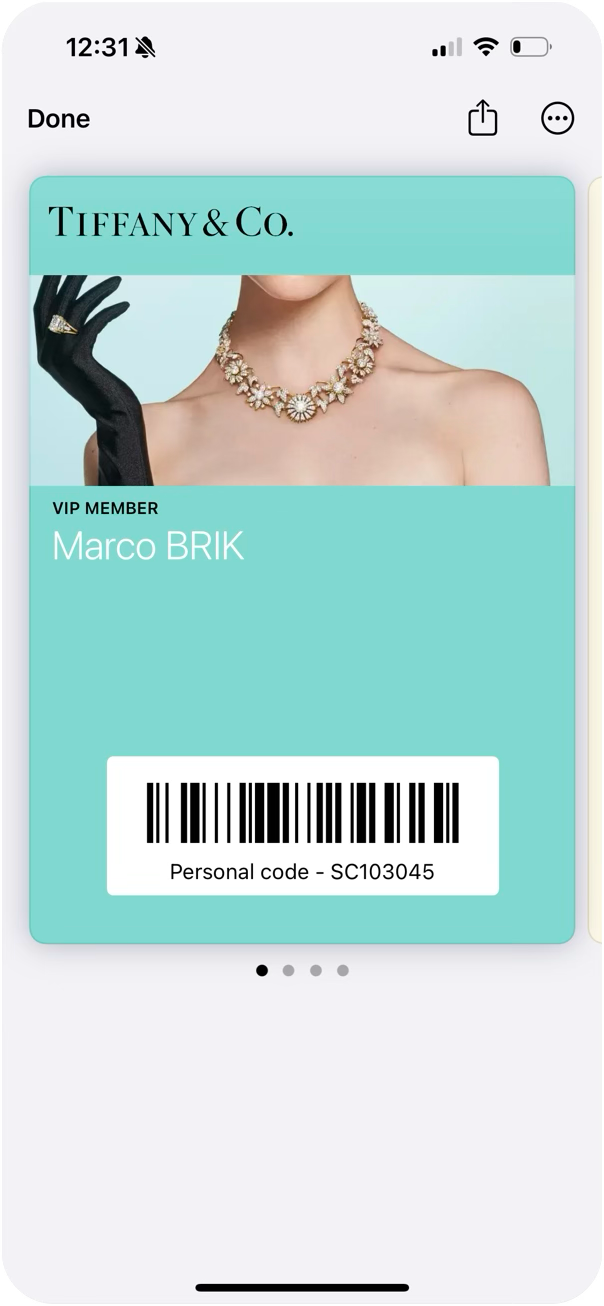
The digital client card enables instant identification when a client enters the store. The advisor knows who they are before the conversation even begins. They can adapt their welcome, their approach, their selection. The technology remains invisible. The human warmth remains intact.
Example
A client arrives in store with their wallet card. At the entrance or checkout, a quick scan (QR code or NFC) identifies them in seconds. Their profile appears on the advisor’s side: purchase history, preferences, last visit.
No friction, no forms. The interaction is immediate, personalized, natural.
Going further
A VIP client arrives for a private appointment. Their wallet card automatically triggers a discreet notification to their dedicated advisor.
The advisor is informed in real time of their arrival, expectations, and visit context. The client sees nothing. They are simply welcomed as if everything had been anticipated.
The certificate of authenticity: giving products a life
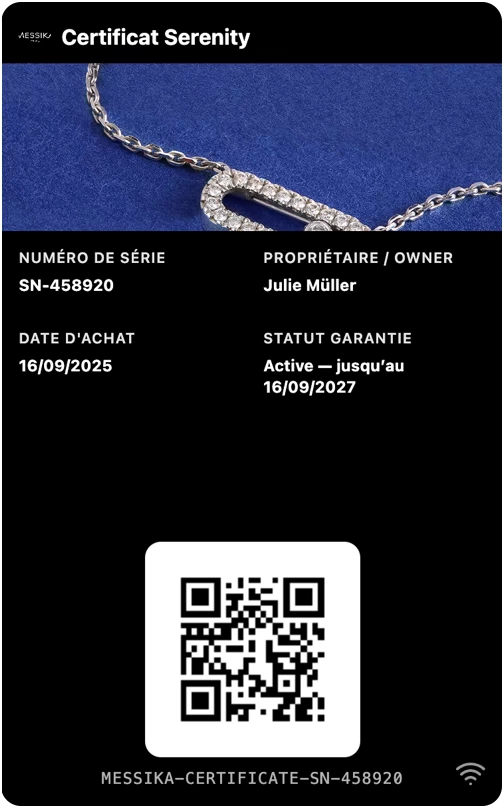
The certificate of authenticity transforms each purchase into a unique, traceable object. The product gains an even more exclusive, almost collectible dimension: its history, origin, and uniqueness are documented and accessible at any time in the client’s pocket. In a sector where counterfeiting is a major issue, this is also a concrete and elegant response to a real problem.
Example
After a purchase, a digital certificate is automatically added to the client’s wallet.
It includes key information: purchase date, product reference, store, authenticity. In case of resale, repair, or verification, the client can present it instantly.
Going further
A piece of jewelry is maintained, repaired, passed on. Each intervention is recorded in the wallet: workshop handling, restoration, cleaning.
The product is no longer just a purchase. It tells a living story, enriched over time. The wallet becomes the product’s digital lifecycle record.
Private invitations: extending the relationship with elegance
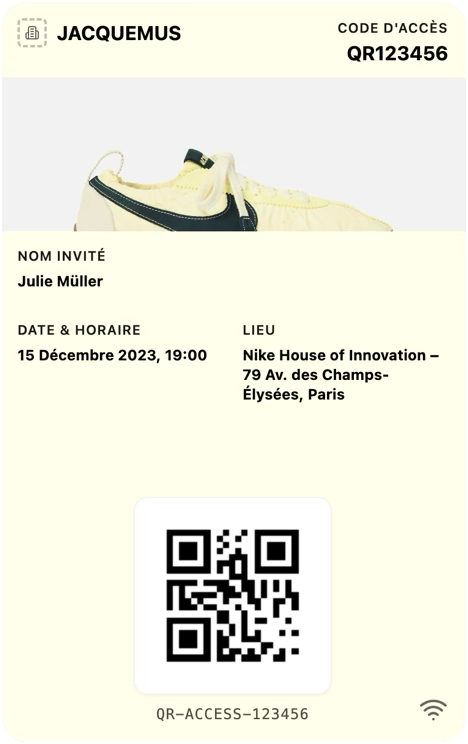
Private invitations may be the most powerful use case. Collection launches, exhibitions, VIP events. The invitation is delivered directly to the client’s wallet. It is individual, secure, seamless, and modern.
Example
A client receives a wallet invitation for a private event. On the day, they simply present their pass at the entrance. A quick scan validates access within seconds, no paper lists, no manual checks. The experience is smooth, premium, effortless.
Going further
A brand creates a wallet card reserved for its top clients. Beyond event access, this card unlocks exclusive experiences, priority access, and personalized attention.
The wallet becomes a marker of belonging. Not a tool. A symbol.
Specific case: discretion and ultra-personalization
During highly confidential visits (VIPs, public figures), no names are exchanged. A secure identifier embedded in the wallet enables instant recognition. The staff is informed, everything is ready, and the welcome happens seamlessly and discreetly. The ultimate luxury: being recognized without ever being exposed.
What the wallet does not do
It would be misleading to claim that the wallet creates clienteling. It does not.
It does not replace the advisor who learned to sketch to gift portraits to their best clients. It does not replace shared lunches, long conversations, or personal moments.
Clienteling remains, above all, a human story. And that humanity cannot be automated.
What the wallet brings is something else. It extends the relationship beyond the limited circle any advisor can realistically maintain. It creates a second layer of connection between the brand and the client, one that is scalable. And above all, it is a relationship that belongs to the brand.
This connection opens a new way of thinking about clienteling. Historically, clienteling relies on the advisor’s tools: CRM, personal notes, purchase history. Valuable knowledge, but often locked within internal systems, or in the advisor’s mind.
The wallet builds a bridge between this internal world and the client. It becomes the visible extension of the relationship on the user’s side. A curated set of information can be shared: a client card, an invitation, a certificate… and more subtly, a direct link to the advisor.
Contact details, point of contact, privileged access: the wallet becomes a form of digital business card, living and contextualized. No longer just a support, but an interface that embodies the relationship.
What if the real luxury of tomorrow was feeling unique… at scale?
The brands that will succeed tomorrow won’t necessarily be those spending the most on communication. They will be those that manage to create, at scale, the feeling that each client matters individually.
The mobile wallet can become a remarkable tool in the hands of brands that truly understand clienteling.
Not to sell. To build lasting relationships.
The wallet: discreet for the client, strategic for the brand
Relationship before transaction
The advisor doesn’t sell, they know their client: preferences, purchase history, important moments, even their size. The client feels recognized, not targeted.
Data serving the human experience
Strong clienteling relies on rich customer data, but it should never be visible. Technology must remain invisible, and human warmth must come first.
The link between visits
The real challenge is what happens between store visits: a personalized message, an invitation, a thoughtful gesture. Not mass marketing.
Perceived exclusivity
Making the client feel unique. Making them feel thought of personally.