

Customer acquisition costs have never been higher. The cost per click on Google Ads has increased by more than 40% in some sectors in recent years. At the same time, the average marketing email open rate has plateaued around 20–25%, while inboxes continue to become more saturated. As for mobile apps, the numbers are clear: 80% of apps are used less than once after being downloaded.
In other words, advertising is becoming more expensive, email is losing effectiveness, and apps are no longer the miracle solution.
In this context, mobile wallets such as Apple Wallet and Google Wallet are emerging as a smoother, more direct acquisition lever that fits naturally into real user behaviors.
Here is why 👇
The real problem: post-interaction anonymity
In most industries, the scenario is always the same:
• A ticket is gifted → the beneficiary remains unknown
• A gift card is used → the brand only knows the buyer
• A customer completes a purchase in store → no CRM connection
• A coupon circulates → the actual user cannot be identified
Modern acquisition relies on a simple principle: identify users in order to activate them later.
Without identification, there is no CRM relationship, no personalization, and no measurable marketing impact.
Wallet as a primary acquisition tool
The strategic value of the wallet relies on three pillars.
• Instant access : a pass can be added in one click via QR code, SMS, email, or a landing page.
• Tangible value : tickets, coupons, loyalty cards, or passes provide an immediate and useful benefit.
• Contextual identification : to receive or activate the pass, the user provides a key piece of information such as an email address, phone number, or unique identifier.
The data is no longer requested for “marketing communication.” It is requested to activate a concrete benefit. This represents a major psychological shift in acquisition logic.
Key advantages of mobile wallets
The wallet reduces entry friction
Every additional step in an acquisition journey reduces conversion rates: creating an account, downloading an app, confirming an email… each extra click increases the likelihood of abandonment.
Mobile wallets change this dynamic. There is no need to download an app or create a full account. A pass can be added instantly via QR code, SMS, email, or a landing page.
Studies show that 22% of online shopping abandonments are caused by mandatory account creation. Less friction means more conversions.
A wallet pass can be added at the exact moment when interest is highest. This creates a logic of instant activation without technical barriers.
The wallet captures the user at the right moment
Wallet interactions usually happen during moments of high engagement, such as:
• making a purchase in store
• registering for an event
• downloading a ticket
• participating in a contest
• scanning a QR code in a physical location
These are moments when the user is already involved.
The wallet simply extends the current action rather than interrupting it. Unlike traditional advertising, this interaction occurs when the user already has high purchase or participation intent.
Adding a pass to a wallet is therefore not an interruption—it is a continuation of the experience.
The wallet connects physical and digital experiences
In retail stores, trade shows, or live events, the same challenge always arises: How do you transform an anonymous visitor into a contact you can activate later?
Mobile wallets provide a simple answer.
Examples include:
• QR codes displayed in store
• tablets used by sales staff
• interactive kiosks
• signage on an event booth
Within seconds, a visitor can add a pass to their phone. From that moment, the connection is created. The wallet becomes a bridge between the physical world and the brand’s digital ecosystem.
It allows companies to:
• identify the pass holder
• associate the pass with a customer account
• enrich CRM databases
• track scans and usage
Anonymous traffic becomes measurable relationships.
The wallet turns a contact into a persistent relationship
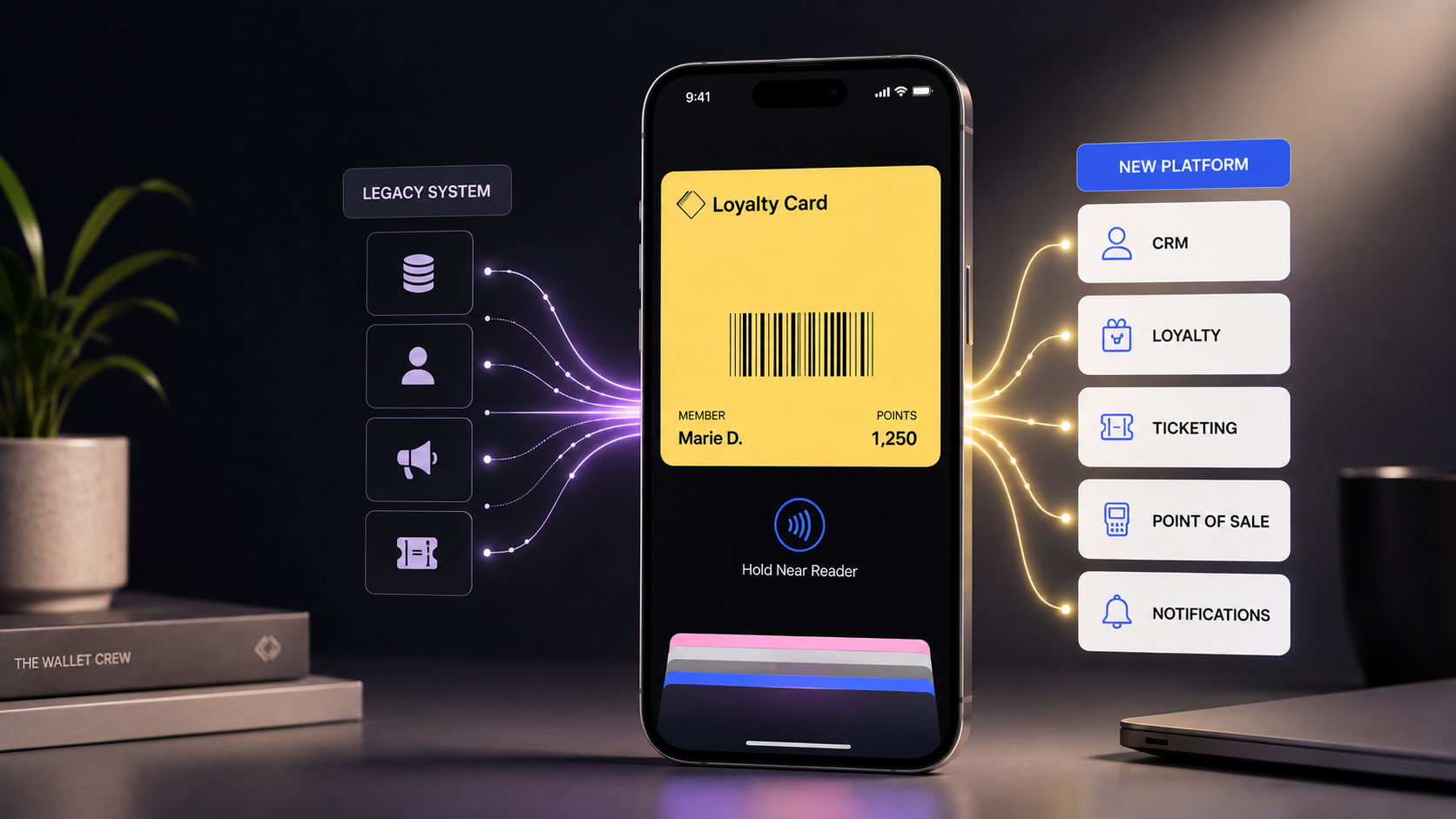
A wallet pass is not just a digital asset. It becomes a persistent presence inside the user’s phone.
Unlike email messages that may never be opened, or mobile app notifications that require prior installation, wallet passes benefit from native integration within the smartphone. They can:
• be updated in real time
• display contextual information
• trigger reminders or notifications
Each pass becomes an opportunity for ongoing interaction. There is also an important strategic dimension often overlooked. In many situations, such as gift cards, event tickets, or certificates—brands know the buyer but not the final beneficiary.
Wallet passes make it possible to:
• identify the real user
• associate the pass with a new customer account
• track downloads and device usage
• limit fraud (multi-device usage, duplication, unauthorized scans)
• control which wallet has actually been used or scanned
Every pass can therefore become an entry point to a new customer relationship.
Detailed use cases
Key consideration: data collection and GDPR compliance
From a GDPR perspective, it is essential to collect only the data that is strictly necessary for the service to function.
Mobile wallets fit naturally within this minimalist approach: a single piece of information (often an email address) is enough to activate the pass and identify the user.
The goal is not to create complex forms, but to collect only the minimum data required to make the service useful and operational.
What actually changes in the acquisition funnel
Traditionally:
Traffic → Form → Drop-off → Incomplete data
With a wallet:
Interaction → Immediate value → Natural identification → Reliable data
Mobile wallets do not replace prospecting efforts.
They optimize the critical moment where an anonymous user becomes an identifiable contact.
In that sense, the wallet should be viewed not as a marketing feature, but as a core infrastructure component of modern customer acquisition strategies.