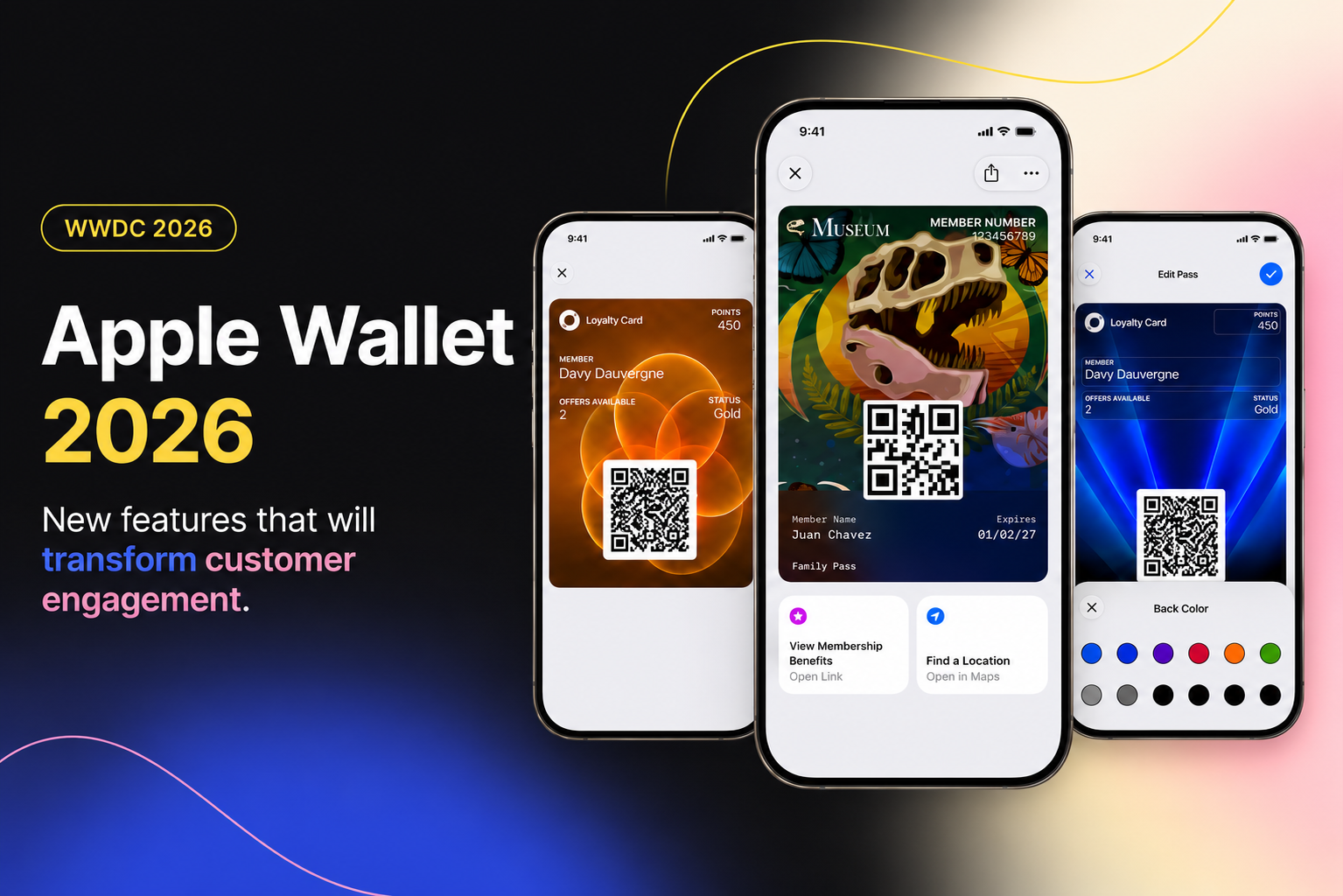

Apple Wallet and Google Wallet have become native environments capable of hosting transactional cards: subscriptions, membership cards, gift cards, coupons.
For SaaS platforms and software vendors, one question keeps coming back:
How can you integrate Apple Wallet and Google Wallet into your product without building, maintaining, and securing an entire technical infrastructure?
Spoiler: you don’t have to build everything yourself.
That’s exactly where Wallet as a Service comes in.
Wallet as a Service: What Does It Actually Mean?
Wallet as a Service (WaaS) is a platform model that enables SaaS vendors to integrate Apple Wallet and Google Wallet without building or operating the full technical stack.
Concretely, instead of:
- developing and maintaining your own pass generation engine,
- operating servers to create, sign, and synchronize wallet passes,
- managing Apple certificates and Google accounts (often for each client in white-label setups),
- maintaining API connections with Apple and Google and tracking their ongoing updates,
- handling real-time updates and the full lifecycle of wallet passes,
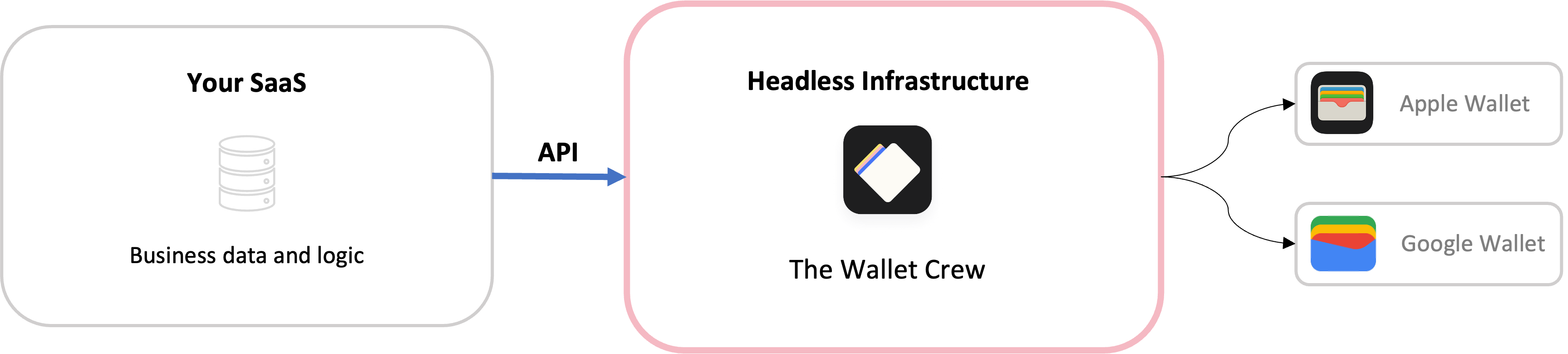
you connect to a specialized wallet platform that operates this infrastructure for you.
On your side, you keep:
- your SaaS product,
- your back office,
- your user journeys,
- your business model,
- your data and your customer relationship.
Wallet as a Service acts as a headless infrastructure layer, fully connected to your existing ecosystem.
Wallet Integration Is Infrastructure, Not a Simple Feature
Integrating Apple Wallet or Google Wallet is not just about adding a button to your interface.
A wallet pass is a connected object tied to your business system.
It must continuously reflect the real-time state of your data: subscription status, balance, validity.
A proper wallet integration requires:
- secure pass generation and signing,
- real-time synchronization with your systems,
- reliable lifecycle management (activation, updates, expiration),
- ongoing compliance with Apple and Google platform requirements.
In other words, wallet integration becomes part of your product architecture.
It is not an isolated feature, but a native extension of your SaaS infrastructure.
Build or Partner: A Strategic Decision
The question is not only technical. It is strategic.
Building your own Apple Wallet and Google Wallet integration may make sense if:
- wallet functionality is core to your value proposition,
- you want full control over the infrastructure,
- you are prepared to handle long-term maintenance and ongoing Apple / Google platform changes.
Partnering with a Wallet as a Service provider is relevant if:
- wallet is an extension of your SaaS product,
- you want to accelerate time-to-market,
- you prefer not to internalize platform-related risks,
- you want your teams focused on your core product roadmap.
In most SaaS models, wallet is not the primary product.
It is a transactional extension layer.
Practical Example: Digitizing Subscriptions with Apple Wallet and Google Wallet
Consider a SaaS platform managing subscriptions (fitness, coworking, mobility, cultural venues).
With wallet integration:
- At signup, users can add their subscription to Apple Wallet or Google Wallet.
- The card contains a unique identifier (QR code or NFC).
- At the reception desk of a gym or the entrance of a cultural venue, the customer presents their card.
- The scan checks in real time with your system to verify that the subscription is active.
- When a subscription is renewed or expires, the status is automatically updated in the wallet.
The wallet becomes:
- a simple identification support,
- a fast way to verify subscription status,
- a real-time reflection of your system.
With a Wallet as a Service approach:
- your business logic remains in your platform,
- no data is duplicated,
- distribution (“Add to Apple Wallet” / “Add to Google Wallet”) is managed,
- synchronization and platform compliance are handled by the wallet provider.
The wallet acts as a digital twin of your infrastructure.
Why The Wallet Crew Fits This Model
The Wallet Crew was designed from day one as a Wallet as a Service platform for SaaS vendors and software ecosystems.
Our approach is:
- Headless
- White-label
- API-first
- Connected to existing platforms
- Built for international scale
- Designed to preserve data ownership and pass ownership
Our goal is simple:
Enable platforms to integrate Apple Wallet and Google Wallet as a native product feature.
Without technical debt. Without hidden complexity. Without diverting your teams from your core roadmap.